
Wills - Trusts - Estates
Serving All of Colorado






Our high net worth clients arrived here two ways, and the planning looks different for each.
Some built it themselves and still run it. They bought real estate and manage it — often across several states, often for decades, often with a basis so low after depreciation and a chain of 1031 exchanges that it bears no relation to what the property is worth today. Or they learned to invest well and never stopped. Either way these are operators, not passengers. They are not going to hand their assets to an institution they expect to do a worse job than they do.
Others earned it as employees. Concentrated employer stock, options, restricted units at a company that grew faster than anyone planned for. The positions we work with in this group run from a few million to nine figures. Clients here usually didn’t set out to be wealthy and often haven’t finished adjusting to it. They still have a job, a manager, a blackout calendar, and an employer that decides whether their shares can move at all.
A third group inherited it. They’re beneficiaries of trusts someone else wrote — a parent, a grandparent — so they didn’t set the terms, don’t hold the assets, and often haven’t been told much. Some come to us because the relationship with the trustee has broken down: distributions declined without explanation, statements that stop arriving, an institution three states away that has never met them. Others arrive wanting an ordinary revocable living trust and mention a family trust partway through the meeting, at which point the conversation changes.
We don’t represent founders of operating businesses. That’s a different practice, and there are firms that do it well.
The federal exemption now stands at $15 million per person and $30 million for a married couple, indexed for inflation beginning in 2027. It is no longer scheduled to be cut in half. That removed a deadline, not the work. For families above the exemption the question shifted from racing a sunset to removing future appreciation before it compounds.
The hardest question is usually basis, not estate tax. Assets you gift during life carry your original basis; assets your heirs inherit get stepped up to fair market value. After twenty years of depreciation and exchanges, that step-up can be worth more than the estate tax you’d save by gifting. The answer is asset by asset, and it is genuinely close in a lot of cases.
Then there’s the problem of where the property sits. Real estate held in your own name in three states means probate in three states. Entities and trusts solve that, and they also let you separate the liability of a property with tenants from the accounts you never want a premises claim to reach.
The other issue is cash. Estate tax is due nine months after death. A portfolio of buildings does not produce that on demand, and heirs who have to sell into a deadline sell badly.
Control is the piece most plans get wrong for this client. You can move assets out of your estate and still direct how they’re invested. Directed trust structures separate the investment function from the distribution function, which means the person who has been picking these assets successfully for thirty years keeps doing it.
Timing decides almost everything. A transfer made while the company’s valuation is low moves a very different number than the same transfer made after a tender offer or an IPO prices the shares. The window is usually narrower than people expect and it closes without warning.
Before any of that, there’s a question most planning conversations skip: can the shares move at all. Private company stock usually comes with transfer restrictions, and a plan that assumes you can gift shares into a trust is worthless if the company’s documents require board consent nobody’s going to give. We read the equity documents first.
Concentration is the risk nobody wants to discuss while the number is going up. Most of your net worth sits in one company, subject to lockups, blackout windows, and — if you’re an officer — Section 16. Diversification, charitable structures, and estate planning all interact with those constraints rather than sitting outside them.
The first job is usually finding out what you actually have. Colorado’s Uniform Trust Code gives qualified beneficiaries the right to information and to accountings, and a trustee who has been vague for years often responds differently to a written request that cites the statute. What the trust says about distribution standards, about who can remove and replace a trustee, and about whether anyone holds a power of appointment matters more than most beneficiaries realize, and many have never read the document.
Old trusts can be fixed more often than people expect. Colorado’s decanting statute and the modification provisions of the Uniform Trust Code let a trust be modernized — a different trustee, a better situs, updated administrative terms, a directed structure that separates investment authority from distribution authority — frequently without going to court. We handle that work on the planning and negotiation side. Where a dispute genuinely has to be litigated, we will say so and help you find trial counsel.
A trust you benefit from also belongs in your own planning whether you control it or not. A general power of appointment can pull trust property into your taxable estate; a limited power lets you direct where the property goes next without that consequence. We have had clients learn which one they hold quite late.
Spousal Lifetime Access Trusts drafted to survive the reciprocal trust doctrine. Grantor Retained Annuity Trusts laddered against the volatility of the specific asset going in. Installment sales to Intentionally Defective Grantor Trusts. Dynasty trusts sitused where the rule against perpetuities lets them run. Wyoming Close LLCs paired with domestic asset protection trusts, which is the structure we reach for most often with real estate.
Diedre Braverman is licensed in Colorado, Wyoming, and California, so the Wyoming work happens in-house rather than getting referred out. When an existing irrevocable trust no longer fits, Colorado’s decanting statute usually lets us fix it without going to court.
Before practicing law, Diedre spent three years as a management consultant at McKinsey & Company. That work meant sitting across from founders and executives and reading a business from the inside — capital structure, governance, what a liquidity event does to a balance sheet and to a family. Clients holding concentrated positions or facing an IPO tend to find that the conversation starts further along here.
Selling appreciated real estate, cashing in a large stock position, or coming into a significant inheritance? The planning that saves the most in taxes – and best protects the proceeds – often has to happen before the money arrives. See how we help Colorado families prepare in planning for a liquidity event and sudden wealth.
Our comprehensive high net worth estate planning process is structured into seven thoughtful stages. Each step ensures your plan is not only technically sound but aligned with your family dynamics, goals, and long-term vision.
We begin by thoroughly reviewing your existing estate planning documents and compiling a full picture of your assets, business interests, and family structure. Equally important, we explore your personal values, long-term goals, and any concerns or questions you may have. This foundation ensures that every decision made is anchored in what matters most to you.
Using the insights gathered, we work collaboratively with you to assemble the right ‘puzzle pieces’ — trusts, entities, tax strategies, charitable structures, and more — to form a cohesive and efficient estate and asset protection plan. Each element is selected to address specific concerns while supporting your broader vision for wealth transfer, asset protection, and family governance.
This is also the step that includes discussion of roles and responsibilities for trustees, medical durable power of attorney agents, beneficiaries, and fiduciaries. We’ll walk with you through your family and friend options, and also explore professional fiduciaries where they can be helpful.
Once the structure and design are in place, we draft all necessary legal documents, carefully tailoring them to your plan. We then walk through each component with you to ensure clarity and your comfort with the documents.
When you are ready, we coordinate the formal signing of all plan documents. In many cases, this occurs simultaneously with the document review phase to streamline the process and maintain momentum.
No estate plan is complete without implementation. Whether your strategy includes trusts, family LLCs, or other entities, these structures only work if properly funded. We guide you through the asset retitling process and coordinate updates to beneficiary designations, working closely with your financial advisors and custodians to ensure precision and efficiency.
We encourage and facilitate a family meeting — a cornerstone of transparency and long-term success. This gathering brings together key individuals named in your plan and anyone else you choose to include. It’s an opportunity to communicate your intentions, clarify roles, and empower your loved ones with understanding and confidence.
Estate planning is not a one-time event. Life evolves, and so should your plan. As part of our long-term commitment, we schedule a review — typically every one to five years — to evaluate how your plan is performing, identify any changes in your goals or the law, and make thoughtful adjustments as needed.
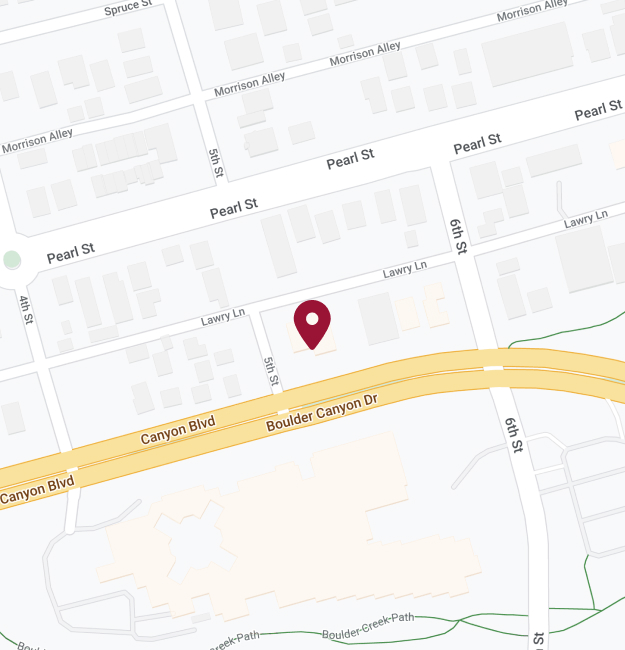
Located in downtown Boulder, across from the Justice Center. Take Canyon Boulevard to 5th Street. Our building is right on the corner of 5th and Canyon, with exposed red brick on the front. We offer onsite underground parking just to the right after you turn onto 5th. An elevator takes you to our open and light offices on the second floor.


