Wills - Trusts - Estates
Serving All of Colorado





Diedre Wachbrit Braverman is licensed to practice law in Colorado, Wyoming, and California. That is unusual, and it matters more than it sounds, because the question we get asked most often by people who have lived in more than one of those states is some version of: do I have to start over?
Usually the answer is no. Sometimes it is yes. What decides it is rarely the thing people expect.
Start with the reassuring part, because most of what you read online overstates the danger.
A will that was validly executed somewhere else stays valid in Colorado. The statute is direct about it. Under C.R.S. § 15-11-506, a written will is valid here if its execution complied with Colorado law, or with the law of the place where it was signed, or with the law of the place where the testator was domiciled, had a place of abode, or was a national, either when it was signed or when they died. Three separate ways to satisfy the requirement. A California will signed in front of two witnesses in Pasadena does not evaporate when you move to Louisville.
Powers of attorney work the same way. C.R.S. § 15-14-706(3) provides that a power of attorney executed outside Colorado is valid here if its execution complied with the law of the jurisdiction that governs its meaning and effect. Colorado adopted the Uniform Power of Attorney Act in part to make these documents portable.
Revocable trusts are the most portable of all. A trust doesn’t have a residence in the way a person does. It has governing law, a trustee, and property, and moving your household doesn’t automatically change any of the three.
So no, you did not become intestate by taking a job in Denver.
The failures we see are almost never failures of validity. They are failures of acceptance and administration, which is a different problem with a different fix.
The bank won’t take the power of attorney. This is the single most common one. Your out-of-state financial power of attorney is legally valid in Colorado, and the branch manager looking at a fifteen-year-old document on unfamiliar letterhead still says no. Colorado gives you a real remedy here that most people never learn about: under C.R.S. § 15-14-720, a person who improperly refuses to accept an acknowledged power of attorney can be ordered to accept it and can be held liable for the attorney fees and costs of the proceeding that makes them. That is genuine leverage. It is also leverage you would rather not need at the exact moment your father is in the hospital and someone has to move money.
The hospital wants its own form. Medical directives are the least portable documents in the plan, not because other states’ documents are invalid, but because a nurse in an emergency department is working from a form she recognizes. If you split your year between Boulder and Palm Desert, having a set of advance directives for each state is not redundancy. It is the whole point.
The trust owns the house in one state and not the other. Somebody sets up a revocable living trust in California, funds the California house into it, buys a place in Steamboat five years later, and takes title in their own name because that is what the title company put in front of them. The trust now misses the second house entirely, and the family gets a Colorado ancillary probate they were told they had avoided. The trust was fine. The funding was not.
The named agents are three states away. A personal representative in Sacramento, a successor trustee in Cheyenne, and a health care agent who has to make a decision about a Boulder hospital by phone. Nothing here is invalid. It is just a plan that will be administered badly.
The beneficiary designations never moved. Retirement accounts and life insurance pass by contract, outside the will and outside the trust, and they are the most commonly forgotten piece of any move.
This is where a document review stops being a formality.
California is a community property state. Colorado and Wyoming are not. Property you and your spouse acquired while living in California carries a character that follows the property, not the zip code. When a couple moves to Colorado with a mix of community property, separate property, and assets acquired after the move, sorting out what is what is real work, and it drives who owns what at the first death.
Spousal rights are structured completely differently. Colorado protects a surviving spouse through an elective share against the augmented estate under C.R.S. § 15-11-202. California has no elective share, because the community property system already gives the surviving spouse an ownership interest rather than a claim. Wyoming has its own elective share regime. A plan drafted against one of these systems and administered under another can produce a result nobody intended.
Income tax is not a wash. Wyoming has no state income tax. Colorado’s is a flat rate. California’s is the highest in the country. For people whose plan includes trusts that accumulate income, this difference is not a rounding error.
If any part of your family is in California, this is the section worth reading twice.
California taxes a trust’s income based on residence, and not only the settlor’s. Under Cal. Rev. & Tax. Code § 17742(a), the tax applies to the entire taxable income of a trust if the fiduciary or a beneficiary whose interest is not contingent is a California resident, regardless of where the settlor lives.
Read that again with your own family in mind. You can be a Boulder resident, with a Colorado trust, drafted by a Colorado lawyer, holding no California property at all, and still be exposed. It takes one California trustee, or one California child with a vested interest, to pull the trust into California’s tax system. Where multiple trustees or beneficiaries are involved, §§ 17743 and 17744 apportion the income rather than taxing all of it, which softens the outcome but does not remove the problem.
This area is moving. In 2026 the Franchise Tax Board issued Legal Ruling 2026-01, addressing when a beneficiary of a wholly discretionary trust is contingent and when that interest becomes noncontingent. The distinction turns on the trust instrument itself, which is exactly the kind of thing that gets decided years before anyone thinks about tax, by whoever chose the distribution language.
We are not California tax counsel and we say so plainly. What we do is draft so the question is asked at the right time, and coordinate with your California CPA before a trustee designation or a distribution standard creates a problem that is expensive to unwind.
Whatever else moves, land does not. Real estate is governed by the law of the state where it sits, and that rule survives every plan you write.
The practical consequence is that a Colorado resident who dies owning a cabin in Wyoming or a rental in California may leave the family with two court proceedings, in two states, at the same time. The Colorado process is the ancillary one when the decedent lived elsewhere and owned property here, and the exposure runs the other direction just as easily.
This is usually preventable, and the prevention is unglamorous. Title the out-of-state property to the trust. Confirm it was actually recorded that way. Check it again after every refinance, because a lender will sometimes require the property out of the trust to close and nobody remembers to put it back.
Some clients come to us because they moved to Wyoming. Others come because they want Wyoming law without living there.
Wyoming’s close limited liability company statutes and its qualified spendthrift trust provisions at W.S. §§ 4-10-510 through 4-10-523 make it a deliberate destination for asset protection and long-term trust planning. We form and administer these structures, and we do it as Wyoming-licensed counsel rather than through a registered agent service.
The honest caveat: Wyoming law does not follow you automatically because you signed a Wyoming document. Qualified trustee requirements, real administration in the state, careful transfer documentation, and the timing of funding all matter. A Wyoming trust administered entirely from a kitchen table in another state invites a fight about whether Wyoming law applies at all. That fight is winnable or losable largely on facts created at formation.
Most clients who move need a review, a set of state-specific medical directives, a fresh financial power of attorney, and confirmation that the trust actually owns what it is supposed to own. That is a modest engagement and we price it that way.
A full restatement makes sense when the underlying structure no longer fits: community property that needs to be characterized, a tax posture that changed with the move, trustee and beneficiary residence that creates an income tax exposure nobody modeled, or a document old enough that the law it was drafted against has been superseded. Colorado’s decanting and modification tools give trustees room to fix an irrevocable trust that has aged badly, often without going to court.
We will tell you which of these you are, including when the answer is that your existing plan is fine and you should spend the money elsewhere.
Being admitted in Colorado, Wyoming, and California means we can draft and advise in all three rather than coordinating three sets of lawyers and hoping the documents agree with one another. For families with property, children, or trustees spread across the Mountain West and the coast, that is generally the difference between a plan and a collection of documents.
We also know where the line is. If your situation reaches into Texas, Florida, or anywhere else we are not admitted, we say so and we bring in local counsel rather than guess.
A first conversation costs nothing and usually sorts the question quickly: which state’s law governs each document you already have, where your property actually sits, and whether anyone in the plan lives somewhere that changes the tax answer.
Call (303) 800-1588, or use the contact form below.
Braverman Law Group, LLC is located in downtown Boulder and serves clients throughout Colorado. Diedre Wachbrit Braverman is licensed in Colorado, Wyoming, and California. This page is educational and is not legal advice; reading it does not create an attorney-client relationship.
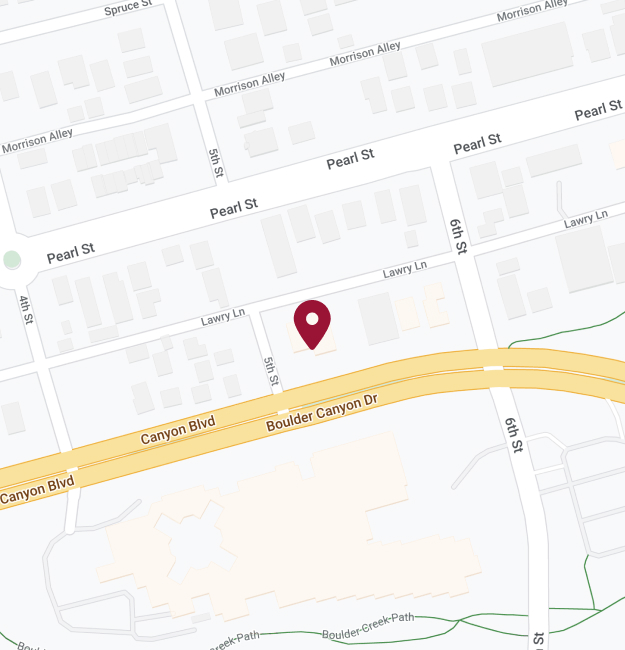
Located in downtown Boulder, across from the Justice Center. Take Canyon Boulevard to 5th Street. Our building is right on the corner of 5th and Canyon, with exposed red brick on the front. We offer onsite underground parking just to the right after you turn onto 5th. An elevator takes you to our open and light offices on the second floor.


